Tomorrow afternoon beginning at 3:30, the WA Senate's Transportation Committee will hold a hearing on several bills:
SB 6772 - Concerning regional transportation governance.
SB 6667 - Establishing high-capacity transportation corridor areas.
SB 6543 - Creating a central Puget Sound regional tolling authority.
SB 6771 - Eliminating regional transportation investment districts.
SB 6495 - Requiring the appointment of nonvoting labor members to public transportation governing bodies.
SB 6569 - Permitting public transit vehicle stops at unmarked stop zones under certain circumstances.
Several of these are bad ideas already panned in past posts to this blog. SB 6772 would implement the recommendations of the Regional Transportation Commission, which RAMP opposes. SB 6543 has a misleading title; what it really does is overthrow existing transit agencies to set up a "central Puget Sound regional transit authority"--another aspect of the RTC's agenda. SB 6771 kills the RTID--which most observers think is already effectively dead--but offers nothing in its place; this is a vaccum that the RTC's proposed uberagency would undoubtedly have to fill. Is a theme starting to appear?
RAMP participants are encouraged to testify, sign in, and/or contact their respective senators.
Showing posts with label RTID. Show all posts
Showing posts with label RTID. Show all posts
Monday, February 04, 2008
Wednesday, January 09, 2008
The RTC Comes To Town (Reprise')
 T-Mobile founder John Stanton and former WA Transportation Secretary Doug McDonald met with RAMP today to seek Pierce County support for reform of regional transportation governance. Their reception by the group was polite but less than encouraging.
Stanton shared his belief that the failure of Proposition 1 was due, in part, to voter fatigue following a series of large, uncoordinated funding requests. He reiterated recommendations of the Regional Transportation Commission, which he chaired, calling for an overhaul of transportation agencies--a move that he feels will lead to more coordination, higher public credibility, and better leveraging of extant transportation funding sources.
McDonald suggested that sub-area equity--a pillar of RAMP's Legislative priorities now for several years--might work against Pierce County's goals. "You won't be able to finance mega projects like SR-167," he opined, "without tapping funding from the entire region." He said that the recent failure of Proposition 1 "convinced him" that he should join Stanton and others in seeking a major new agency that would replace groups like Sound Transit and the Puget Sound Regional Council.
RAMP's participants weren't buying. WA Senator Jim Kastama (who was a leader in crafting the Nickel Package as well as the RTID legislation) was quick to disagree. He claimed that King County did a much poorer job of prioritizing investments for the Roads & Transit package, and that this weakness would be magnified in a proportionally representative body--the entity proposed by the RTC.
Following a robust discussion, participants moved forward to adopt RAMP's 2008 Legislative Priorities. At the forefront was the statement that "a Transportation Benefit District is the most viable vehicle for advancing towards the next voter-approved funding package, whether Pierce County moves forward unilaterally or in cooperation with other counties."


Monday, December 31, 2007
Another Voice: Shawn Bunney
 There's already been some Sturm und Drang across the blogosphere regarding Shawn Bunney's recent letter to Washington Governor Christine Gregoire, in which he blames King County Executive Ron Sims and The Seattle Times for the defeat of the Roads & Transit package in November. The letter was sent November 28th and widely disseminated around Pierce County, even being incorporated into Bunney's year-end report to his constituents.
Bunney's been involved in the regional struggle over transportation funding as chair for the Regional Transportation Investment District (RTID), the agency whose mission was to develop the roads portion of the package. The letter is certainly a brash one--some might say its tone is downright nasty--and it ends with a request for Gregoire to embrace transportation needs more widely dispersed than just King County.
In the letter, Bunney attacks Seattle and King County interests for grabbing--and continuing now to grab for--an inordinate share of the region's revenues for mobility investments:
I am sure that before voters went to bed on election night some Seattle legislators were busy ramping up for another raid of the region's roads funds... funds they say are for a $4.4 billion "Safety" project called the 520 Bridge.Certainly Bunney's argument has merit--as has been previously observed by this blog, Pierce County (and every other county in the state save one) has been shorted its fair share of funding, as in 2005 when the Transportation Partnership package delivered 65% of the statewide revenues to King County. That's a sure sticking point which any effort to develop a new regional package will have to address before it can move forward.
This is the same group that siphoned $700 million in gas taxes out of Pierce County in the past 15 years.
We heard this same story yet again in 2006 when the same Seattle interests took almost $400 million out of Pierce County wallets to replace the Alaskan Way Viaduct; a viaduct, it turns out, not wanted by Seattle because it blocks the view.
Monday, December 03, 2007
RAMP Gathers Support for Next Funding Effort
 RAMP's Co-Chairs are inviting broad participation in an upcoming discussion about this area's future mobility--a discussion that will help Pierce County move forward in a coordinated, effective manner to prepare for the 2008 Legislative Session and, beyond that, the next effort to secure funding needed for critical transportation projects.
Co-Chair David Graybill will be addressing the Tacoma City Council's Committee of the Whole next Tuesday afternoon to invite their participation in the consensus process. RAMP's other participants are likewise being encouraged to take part, and RAMP is making a special effort to communicate with those jurisdictions that haven't been involved or that have been only occasionally involved to encourage their involvement in this process.
Particpants in the December 5th RAMP meeting will consider a number of potential venues for funding Pierce County transportation projects, including:
- Forming a Pierce County RTID;
- Working with other counties (King & Snohomish/Thurston & Kitsap) to form a new regional RTID;
- Creating new Transportation Benefit District(s);
- Pursuing local option gas tax increase(s);
- Developing a congestion pricing pilot project
Participants will have a briefing on why the public rejected the recent Roads & Transit proposal from Ian Stewart, principal in EMC Research, who has recently completed a regional survey on behalf of Sound Transit.
Friday, November 30, 2007
Survey Says: Voters Rejected Package, Not Projects
 Sound Transit has just released results of a recent public opinion survey of about 1,000 registered voters across the region. The survey work was conducted by EMC Research and Moore Information to help analyze and understand the results on Proposition 1. In brief, the survey results suggest that the region's voters rejected Proposition 1 because they saw the measure as a whole as too big and too expensive; nevertheless, traffic/transportation issues continue to be the runaway top concern for those same regional voters.
Few voters understood the costs of the package or what it would cost them personally, the survey results suggest, and the vote did not seem to be a referendum on individual roads and transit projects in the package. Looking forward, voters indicate a strong preference towards future transportation measures separating roads from transit and addressing fewer projects in each package. Survey respondents also said that future transportation measures should take a more incremental approach and contain strong, clear accountability measures.
Researcher Ian Stewart will present results of the survey at the next RAMP meeting, December 5th.
Friday, June 15, 2007
Details of the Deal
 Submitted by Paul Ellis
A $7 billion roads package for King, Snohomish and Pierce counties is finally ready for the approval of the region’s voters. It will be combined with Sound Transit's $10.8 billion light rail, bus and commuter rail package in a single question on this November’s ballot.
The Regional Transportation Investment District (RTID) chaired by Pierce County Councilmember Shawn Bunney approved the final roads package last week after some tense negotiations in which elected officials and environmentalists compromised over the controversial Cross-Base Highway near Fort Lewis. RAMP has been and remains a staunch advocate for this critical “missing link” in the regional highway network, linking Spanaway and Frederickson to Interstate 5. The approved package allocates $427 million on interchange and nearby road projects, including at least $10 million for environmental work; however, the crucial center of the project can't be started until after talks with a mediator in 2009--and after another $200 million is found to complete the project.
Sound Transit is proposing a 50-mile light-rail-expansion to the Tacoma Dome in the south, near Mill Creek in the north and Redmond to the east by 2027—building on the 19 miles currently underway. The package also includes 11,200 new parking stalls, 7 new/improved Sounder Commuter rail stations, and enhanced bus and commuter rail service.
The capital costs of the transit improvements is currently estimated at $10.8 billion. The transit part of the package would boost the sales tax by a nickel per $10 purchase, which officials estimate would run about $125 a year for a typical household.
The roads portion of the package would mainly pay for highway lanes that can't be funded through gas taxes alone. The adopted package retains SR-167 as the marquee investment in Pierce County and allocates funding for the Cross-Base Highway. Other Pierce County improvements to be funded through this package include improvements to SR-410/SR-162, enhanced access to Tacoma Mall, and non-motorized improvements.
The road improvements would be funded by a sales-tax increase of 1 cent per $10 purchase and an annual car-tab tax of $80 per $10,000 of vehicle value. The capital cost of the roads package is $7.0 billion in 2006 dollars.
The Gig Harbor Peninsula and areas of Pierce County beyond Orting are outside the Sound Transit and RTID districts and will be exempted from taxes and fees that will be levied if the combined package is approved by the region’s voters.
The Regional Transportation Investment District (RTID) chaired by Pierce County Councilmember Shawn Bunney approved the final roads package last week after some tense negotiations in which elected officials and environmentalists compromised over the controversial Cross-Base Highway near Fort Lewis. RAMP has been and remains a staunch advocate for this critical “missing link” in the regional highway network, linking Spanaway and Frederickson to Interstate 5. The approved package allocates $427 million on interchange and nearby road projects, including at least $10 million for environmental work; however, the crucial center of the project can't be started until after talks with a mediator in 2009--and after another $200 million is found to complete the project.
Sound Transit is proposing a 50-mile light-rail-expansion to the Tacoma Dome in the south, near Mill Creek in the north and Redmond to the east by 2027—building on the 19 miles currently underway. The package also includes 11,200 new parking stalls, 7 new/improved Sounder Commuter rail stations, and enhanced bus and commuter rail service.
The capital costs of the transit improvements is currently estimated at $10.8 billion. The transit part of the package would boost the sales tax by a nickel per $10 purchase, which officials estimate would run about $125 a year for a typical household.
The roads portion of the package would mainly pay for highway lanes that can't be funded through gas taxes alone. The adopted package retains SR-167 as the marquee investment in Pierce County and allocates funding for the Cross-Base Highway. Other Pierce County improvements to be funded through this package include improvements to SR-410/SR-162, enhanced access to Tacoma Mall, and non-motorized improvements.
The road improvements would be funded by a sales-tax increase of 1 cent per $10 purchase and an annual car-tab tax of $80 per $10,000 of vehicle value. The capital cost of the roads package is $7.0 billion in 2006 dollars.
The Gig Harbor Peninsula and areas of Pierce County beyond Orting are outside the Sound Transit and RTID districts and will be exempted from taxes and fees that will be levied if the combined package is approved by the region’s voters.
Paul Ellis is lead staff for RAMP; an employee of the Tacoma-Pierce County Chamber, Ellis led the Pierce County Transportation Advisory Committee (PCTAC), the community’s largest transportation planning effort.
Tuesday, June 12, 2007
Cross-Base Salvaged As Regional Roads Plan Moves Forward
 Submitted by Paul Ellis
The county councils for Pierce, King and Snohomish counties approved the roads portion of a $17.7 billion package last Friday. The resulting Roads & Transit plan is a new approach to transportation--it marries transit and highway investments to create the first integrated transportation system for the entire Puget Sound region.
Last-minute negotiations over the Cross-Base Highway--long a project supported by RAMP--threatened to pit environmentalists throughout the region against the joint ballot measure, but all-night talks resulted in a proposal that most environmentalists will not oppose, according to Bill LaBorde of Environment Washington.
All three elected bodies must now adopt ordinances to put the measure on the ballot in November.
Paul Ellis is lead staff for RAMP; an employee of the Tacoma-Pierce County Chamber, Ellis led the Pierce County Transportation Advisory Committee (PCTAC), the community’s largest transportation planning effort.
Thursday, May 10, 2007
Will RTID Drop the Cross-Base Highway?
 Submitted by Paul Ellis
The News Tribune will report tomorrow that RTID Chair Shawn Bunney is considering removal of that segment of the Cross-Base Highway that crosses the military bases from November's Roads & Transit package.
Bunney's working proposal would fund improvements to Interstate 5 at the Thorne Lane intersection (comprising nearly 60% of the total project cost) on the west side of the project and accelerate funding for improvements on the east side of the project, primarily to 176th St. E. and Canyon Rd. What Bunney calls the "controversial middle portion" of the project would be left "to resolve at a later date". Bunney characterizes himself as a staunch supporter of the project, no matter how the package ultimately presented to voters turns out.
Meanwhile, the Washington State Department of Transportation is about to release a cost/benefit analysis of the Cross-Base Highway recently conducted by HDR/HLB. This analysis compares building the highway to widening of SR-7 and to enhancing transit services in terms of impacts upon congestion, safety, and emissions reduction. Look for more details in an upcoming post.
Paul Ellis is lead staff for RAMP; an employee of the Tacoma-Pierce County Chamber, Ellis led the Pierce County Transportation Advisory Committee (PCTAC), the community’s largest transportation planning effort.
Monday, April 30, 2007
The Road Ahead
Submitted by Paul Ellis
Other than the long-awaited opening of the second Narrows Bridge (or, arguably, the ongoing rebuild of I-5 through the middle of Tacoma), the biggest transportation issue this year will be the integrated Roads & Transit vote on the November ballot. This referendum will have a crucial impact upon regional transportation funding for years to come.
Here's the schedule ahead for how the package will be finalized and presented:
Other than the long-awaited opening of the second Narrows Bridge (or, arguably, the ongoing rebuild of I-5 through the middle of Tacoma), the biggest transportation issue this year will be the integrated Roads & Transit vote on the November ballot. This referendum will have a crucial impact upon regional transportation funding for years to come.
Here's the schedule ahead for how the package will be finalized and presented:
□ January-April 2007:Paul Ellis is lead staff for RAMP; an employee of the Tacoma-Pierce County Chamber, Ellis led the Pierce County Transportation Advisory Committee (PCTAC), the community's largest transportation planning effort.
√ RTID gathers public input on draft plan
√ RTID & Sound Transit continue integrating road and transit plans
□ Late spring 2007: RTID & Sound Transit finalize plans
□ Summer 2007: County councils vote to place road plan on ballot
□ November 2007: Public votes on Roads & Transit package
Tuesday, April 17, 2007
Sierra Club Letter Blasts RTID Plan
Submitted by Paul Ellis
A recent post on this blog chronicled the Sierra Club's over-the-top rhetoric in opposing inclusion of any new road projects in the regional Roads & Transit ballot proposition that will be submitted to voters this November. In a recent letter to Sound Transit Chair John Ladenburg (who is also the Co-Chair for RAMP), the Seattle chapter of the Sierra Club says it will not support the draft proposal now under consideration.
The group's list of problems with the draft package is a long one, including project selection, ballot structure and the revenue sources currently identified to pay for the project. The Sierra Club opines that user taxes--including a new local gas tax--make the most sense for the plan.
The letter concludes with a scathing assessment of the draft package and a recommendation that transit improvements be presented for voter approval independently road projects. "The RTID package contains inappropriate projects and is fraught with structural defects that require changes in the authorizing legislation," the Sierra Club contends. "We do support allowing Sound Transit to proceed separately to the November 2007 ballot."
Paul Ellis is lead staff for RAMP; an employee of the Tacoma-Pierce County Chamber, Ellis led the Pierce County Transportation Advisory Committee (PCTAC), the community's largest transportation planning effort.
A recent post on this blog chronicled the Sierra Club's over-the-top rhetoric in opposing inclusion of any new road projects in the regional Roads & Transit ballot proposition that will be submitted to voters this November. In a recent letter to Sound Transit Chair John Ladenburg (who is also the Co-Chair for RAMP), the Seattle chapter of the Sierra Club says it will not support the draft proposal now under consideration.
The group's list of problems with the draft package is a long one, including project selection, ballot structure and the revenue sources currently identified to pay for the project. The Sierra Club opines that user taxes--including a new local gas tax--make the most sense for the plan.
The letter concludes with a scathing assessment of the draft package and a recommendation that transit improvements be presented for voter approval independently road projects. "The RTID package contains inappropriate projects and is fraught with structural defects that require changes in the authorizing legislation," the Sierra Club contends. "We do support allowing Sound Transit to proceed separately to the November 2007 ballot."
Paul Ellis is lead staff for RAMP; an employee of the Tacoma-Pierce County Chamber, Ellis led the Pierce County Transportation Advisory Committee (PCTAC), the community's largest transportation planning effort.
Thursday, April 12, 2007
Step It Up!--the Rhetoric, Anyway
Submitted by Paul Ellis
The silliness continues from the Sierra Club as its staff deploys over-the-top invective in support of the group's Step It Up! campaign. They're kicking off the drive, evidently, by stepping up the rhetoric.
In an Earth Day guest editorial in The Seattle Times, Aaron Robins and Tim Gould of the Sierra Club's Cascade Chapter describe the Regional Transportation Investment District's Blueprint for Progress proposal as "an Eisenhower-era roads package that drives us the wrong way on climate change impacts and community planning"; having construction of any new roads "shackled at the ballot to the Sound Transit Phase 2 proposal," they contend, is "like trying to lose weight while consuming triple-fudge sundaes with your whole grains--one negates the benefits of the other."
Paul Ellis is lead staff for RAMP; an employee of the Tacoma-Pierce County Chamber, Ellis led the Pierce County Transportation Advisory Committee (PCTAC), the community's largest transportation planning effort.
The silliness continues from the Sierra Club as its staff deploys over-the-top invective in support of the group's Step It Up! campaign. They're kicking off the drive, evidently, by stepping up the rhetoric.
In an Earth Day guest editorial in The Seattle Times, Aaron Robins and Tim Gould of the Sierra Club's Cascade Chapter describe the Regional Transportation Investment District's Blueprint for Progress proposal as "an Eisenhower-era roads package that drives us the wrong way on climate change impacts and community planning"; having construction of any new roads "shackled at the ballot to the Sound Transit Phase 2 proposal," they contend, is "like trying to lose weight while consuming triple-fudge sundaes with your whole grains--one negates the benefits of the other."
Paul Ellis is lead staff for RAMP; an employee of the Tacoma-Pierce County Chamber, Ellis led the Pierce County Transportation Advisory Committee (PCTAC), the community's largest transportation planning effort.
Wednesday, March 28, 2007
RTID: Time is Running Out to Comment
Friday is the deadline for comments to be submitted to the Regional Transportation Investment District (RTID) regarding the Blueprint for Progress proposal that will comprise the roads portion of the Roads & Transit ballot request in November.
RAMP has submitted a letter representing Pierce County's collective consensus, and a similar letters have been sent to RTID from the Frederickson, Parkland & Spanaway Division and the Port-Industrial Committee of the Tacoma-Pierce County Chamber. Interest groups in King County are running an advertising campaign in their local media asking people to write letters opposing the Cross-Base Highway (SR-704), so communications from highway supporters are critically important.
To submit a letter or e-mail to RTID:
Mailing Address
Attn: Kjristine Lund
Regional Transportation Investment District
411 University St., Suite 1200
Seattle, WA 98101
E-mail Address
klund@lundconsulting.com
RAMP has submitted a letter representing Pierce County's collective consensus, and a similar letters have been sent to RTID from the Frederickson, Parkland & Spanaway Division and the Port-Industrial Committee of the Tacoma-Pierce County Chamber. Interest groups in King County are running an advertising campaign in their local media asking people to write letters opposing the Cross-Base Highway (SR-704), so communications from highway supporters are critically important.
To submit a letter or e-mail to RTID:
Mailing Address
Attn: Kjristine Lund
Regional Transportation Investment District
411 University St., Suite 1200
Seattle, WA 98101
E-mail Address
klund@lundconsulting.com
Wednesday, March 21, 2007
Invitation to RAMP Participants
RAMP participants are encouraged to take part in a one-day workshop next Wednesday, March 28th, sponsored by the Regional Transportation Investment District (RTID). Collectively entitled The Path Forward, the workshop will present a series of sessions focusing on three important policy areas: tolling and congestion pricing; carbon assessment and greenhouse gases; and construction mitigation.
The format for each session will be a brief presentation by panelists followed by a facilitated discussion, and then a question–and–answer session with the audience. The outcome from the workshop will be a record of proceedings, with suggestions for policy direction for the RTID Executive Board on each of the three topics.
For more information about next week's event, please visit the RTID website. RAMP participants interested in attending should RSVP for the session or sessions they would like to attend.
The format for each session will be a brief presentation by panelists followed by a facilitated discussion, and then a question–and–answer session with the audience. The outcome from the workshop will be a record of proceedings, with suggestions for policy direction for the RTID Executive Board on each of the three topics.
For more information about next week's event, please visit the RTID website. RAMP participants interested in attending should RSVP for the session or sessions they would like to attend.
Friday, March 02, 2007
Sierra Club (Surprise!) Pans Proposed RTID Package
 Submitted by Paul Ellis
The Sierra Club recently announced that it will push for a carbon emission assessment to be included in every regional transportation plan being developed in Washington State--in particular, the regional Roads & Transit measure expected to be on the ballot in November.
"Unfortunately, RTID has proposed a road construction package that does not address our region's immediate need to address global warming," wrote club officials in a release. The club is asking RTID to amend its proposed package to meet the following goals:
- Prioritize public health and safety projects above highway expansion;
- Reframe the goals of projects to move people and goods, not just cars;
- Emphasize projects that improve reliability of public transit and reduce single-occupancy vehicles; and
- Introduce tolling on all limited-access highways to reduce congestion, increase efficiency and decrease global warming emissions.
The group also states that it is pushing for SB6001 during this Legislative Session. The bill, if adopted by the Legislature, would establish goals for the statewide reduction in greenhouse gas emissions and reduction in petroleum use, and would direct officials to design and recommend a comprehensive set of measures to accomplish those goals.
Paul Ellis is lead staff for RAMP; an employee of the Tacoma-Pierce County Chamber, Ellis led the Pierce County Transportation Advisory Committee (PCTAC), the community's largest transportation planning effort.
Monday, February 19, 2007
Invitation to RAMP Participants
During the months of February and March, Sound Transit and the Regional Transportation Investment District (RTID) are seeking public input on the draft Roads & Transit package.
The Roads & Transit package will present to voters a unified program of investments in freeways, light rail, commuter rail, HOV lanes, park-and-ride lots, and express and local bus service. Key features include:
- Reduction in traffic delays
- Faster travel times
- 42 miles of new light rail
- Major improvements to “highways of regional significance” and chokepoints--including I-5, I-405, SR-167, and the Cross-Base Highway
- 10,000 new park-and-ride stalls
- New HOV lanes
- Bike lanes, sidewalks, better connections
- Major freight routes improved
RAMP participants are encouraged to let Sound Transit and the RTID know if they're on the right track before a final Roads & Transit ballot is adopted for voter consideration in November:
- Monday, March 5th
- 4:30 – 7:30 p.m.
- Washington State History Museum
1911 Pacific Ave, Tacoma
Monday, January 29, 2007
RTID Approves Roads Package
Submitted by Paul Ellis
On Friday the Regional Transportation Investment District (RTID) approved the revised Blueprint for Progress, a preliminary plan for major road and bridge improvements in Pierce, King and Snohomish counties. This package will comprise the roads portion of the Roads & Transit plan that will be submitted to the region's voters on the November ballot.
Projects supported by RAMP--completion of SR-167, construction of SR-704 (the Cross-Base Highway), and widening of SR-162--were included in the proposal adopted on Friday. RAMP participants P.J. McDonald (Fife Chamber) and John Austin (Toray Composites), as well as staff team member Sean Egan, spoke in favor of the Cross-Base Highway--which continues to face opposition from some members of the environmental community.
RTID also took action to increase funding for the SR-520 bridge replacement by $300 million (for a total regional contribution of $1.1 billion), funding new capacity for a six-lane bridge proposal. The RTID district boundary was also approved.
Paul Ellis is lead staff for RAMP; an employee of the Tacoma-Pierce County Chamber, Ellis led the Pierce County Transportation Advisory Committee (PCTAC), the community's largest transportation planning effort.
On Friday the Regional Transportation Investment District (RTID) approved the revised Blueprint for Progress, a preliminary plan for major road and bridge improvements in Pierce, King and Snohomish counties. This package will comprise the roads portion of the Roads & Transit plan that will be submitted to the region's voters on the November ballot.
Projects supported by RAMP--completion of SR-167, construction of SR-704 (the Cross-Base Highway), and widening of SR-162--were included in the proposal adopted on Friday. RAMP participants P.J. McDonald (Fife Chamber) and John Austin (Toray Composites), as well as staff team member Sean Egan, spoke in favor of the Cross-Base Highway--which continues to face opposition from some members of the environmental community.
RTID also took action to increase funding for the SR-520 bridge replacement by $300 million (for a total regional contribution of $1.1 billion), funding new capacity for a six-lane bridge proposal. The RTID district boundary was also approved.
Paul Ellis is lead staff for RAMP; an employee of the Tacoma-Pierce County Chamber, Ellis led the Pierce County Transportation Advisory Committee (PCTAC), the community's largest transportation planning effort.
Thursday, December 28, 2006
Counting the Cost for Regional Projects
 Submitted by Paul Ellis
In September, WSDOT issued revised cost estimates for the SR-520 and Alaskan Way Viaduct projects using a methodology called Cost Estimate Validation Process; since then, the agency has been working to bring the cost estimates for other regional projects up to date. WSDOT just released the updated cost estimates for state highway projects included within the RTID Blueprint for Progress developed last January.
Cost Estimate Validation Process (CEVP) is an intense workshop in which a team of top engineers and risk managers from local and national private firms and public agencies examine a transportation project and review project details with WSDOT engineers. CEVP evaluation of regional projects reflects the increases that have occurred with respect to commodity prices and/or impacts from revisions or refinements to project scopes, risk factors like potential for increased environmental mitigation cost or unforeseen changes in design standards for seismic safety, and roughly a 3.5% rate of inflation per year.
WSDOT's updated estimates put the following price tags on key projects promoted by RAMP:
- SR-167 extension - $1.468 billion
- SR-704 construction - $453 million
- SR-162 improvements - $286 million
Paul Ellis is lead staff for RAMP; an employee of the Tacoma-Pierce County Chamber, Ellis led the Pierce County Transportation Advisory Committee (PCTAC), the community's largest transportation planning effort.
Tuesday, December 05, 2006
Update on RTID
Submitted by Paul Ellis
Over the next few months, the Regional Transportation Investment District (RTID) will need to make tough decisions about which roads and bridges will be included in the regional Roads & Transit ballot measure next November.
Work to date is incorporated in the Blueprint for Progress, a draft proposal created by the RTID Executive Board that proposes regional road and bridge investments in key highway corridors in Snohomish, Pierce and King counties. The RTID Executive Committee will meet January 12th to discuss the Blueprint and possible changes to the plan; RTID hopes to adopt a draft Blueprint at their January 26th Executive Committee meeting.
In February the Executive Committees of RTID and Sound Transit will launch a joint effort to gather input on the integrated Roads & Transit effort.
Paul Ellis is lead staff for RAMP; an employee of the Tacoma-Pierce County Chamber, Ellis led the Pierce County Transportation Advisory Committee (PCTAC), the community's largest transportation planning effort.
Over the next few months, the Regional Transportation Investment District (RTID) will need to make tough decisions about which roads and bridges will be included in the regional Roads & Transit ballot measure next November.
Work to date is incorporated in the Blueprint for Progress, a draft proposal created by the RTID Executive Board that proposes regional road and bridge investments in key highway corridors in Snohomish, Pierce and King counties. The RTID Executive Committee will meet January 12th to discuss the Blueprint and possible changes to the plan; RTID hopes to adopt a draft Blueprint at their January 26th Executive Committee meeting.
In February the Executive Committees of RTID and Sound Transit will launch a joint effort to gather input on the integrated Roads & Transit effort.
Paul Ellis is lead staff for RAMP; an employee of the Tacoma-Pierce County Chamber, Ellis led the Pierce County Transportation Advisory Committee (PCTAC), the community's largest transportation planning effort.
Friday, October 27, 2006
Road & Transit Elements Emerging
 Submitted by Paul Ellis
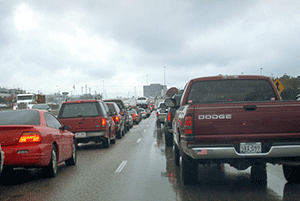
As explained here on September 11th, Sound Transit and the Regional Transportation Investment District (RTID) are working together on an integrated Roads and Transit Plan that will include multiple extensions of regional transit services along with major road improvements. The specific projects that may be presented for voter approval next November are gradually becoming somewhat clearer.
In July, Sound Transit unveiled three sample investment options that provide a vision of what the transit piece of the future regional system could look like--different scenarios combining new investments in light rail, regional buses, park-and-ride lots, HOV access lanes, transit centers and improved commuter train (Sounder) service. Since that time, more than 5,000 people from throughout the region have taken the time to comment on these options. The maximized rail extension option received the strongest support--and by a wide margin (77%). A telephone survey of the region’s residents underscored the public comments’ call for this option.
Today marks the deadline for public comments on the roads portion of the Plan, coordinated by the RTID. Written comments have been provided by RAMP in addition to participating groups such as the Port of Tacoma and the Economic Development Board.
One major area of concern noted to varying degrees in these comments is the likelihood that neither package (as they now stand, at least) adequately provides the regional connections Pierce County wants and needs, such as light rail all the way to SeaTac Airport and completion of SR-167 to I-5. The die may have been cast in the 2005 Session when the Transportation Partnership fund distribution assigned less than 5% of spending to Pierce County projects.
The ultimate question is this one--when voters are asked next November to open their wallets one more time for transportation improvements, will there be enough on the ticket to make the cost worthwhile?
Paul Ellis is lead staff for RAMP; an employee of the Tacoma-Pierce County Chamber, Ellis led the Pierce County Transportation Advisory Committee (PCTAC), the community’s largest transportation planning effort.
Subscribe to:
Posts (Atom)


 Posts
Posts


